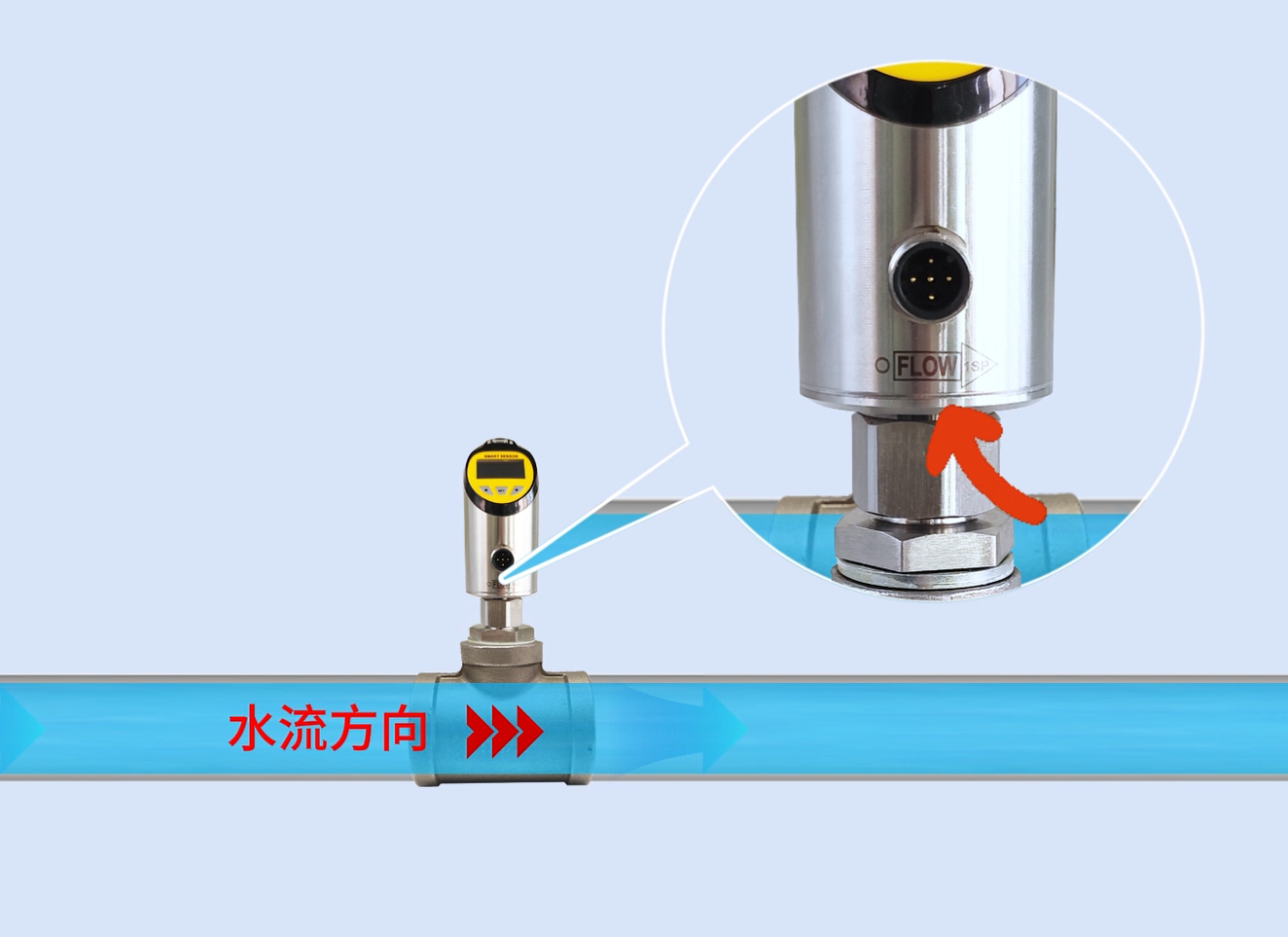
Monitoring the flow of coolant within pipelines is critical for ensuring the normal operation of equipment in industrial production.Whether in petrochemicals,power generation,metallurgy,papermaking,food processing,or water treatment industries,operating equipment generates significant heat,necessitating the use of coolants or cooling water for temperature regulation.Abnormal fluid flow can cause severe equipment damage,leading to system failures or production stoppages.As an engineer,I deeply understand the importance of flow monitoring equipment in safeguarding equipment and enhancing production efficiency.Electronic flow switches,recognized for their excellent performance and high cost-effectiveness,are widely adopted across various sectors.Particularly in applications demanding high flow rates and precise control,thermal dispersion flow switches present an ideal solution.

Why Recommend Thermal Dispersion Flow Switches?
From an engineer's perspective,the advantages of thermal dispersion flow switches lie primarily in their high accuracy,sensitivity,and reliability.Here is my analysis of their core strengths:
1. Highly Accurate Flow Monitoring:
Thermal dispersion flow switches operate based on the principle of heat transfer.This principle enables them to monitor velocity changes within pipes with high precision and sensitivity.At the core of the flow switch are integrated heating and temperature sensing elements.Changes in fluid velocity are detected by measuring variations in heat transfer.When fluid flows through the pipe,the rate of heat conduction changes.The temperature sensing element accurately captures these subtle changes,processes the signal,and outputs flow data.Compared to traditional mechanical flow switches,this principle offers lower flow loss and higher accuracy.
2. Rapid Response&Alarm Functionality:
In industrial applications,flow anomalies can have serious consequences.Sudden changes in flow rates within fluid systems can lead to pump dry-running,equipment damage,or production interruption.Thermal dispersion flow switches respond to flow changes extremely quickly.They feature LED indicators that display the real-time flow status:a red light illuminates when the flow rate falls below the setpoint,and a yellow light activates when the flow meets or exceeds the setpoint.This clear visual feedback allows field engineers to quickly assess the system status and take immediate action,preventing system failures and downtime.
3. Easy Adjustment and Setting:
Engineers often need to adjust the flow switch setpoint based on different operating conditions.Thermal dispersion flow switches are designed for easy adjustment.Simply unscrew the protective screw and use a screwdriver to turn the adjustment knob to set the desired flow alarm point.This straightforward setup method increases operational efficiency and reduces time spent on installation and commissioning.
4. Robust Durability and Protection:
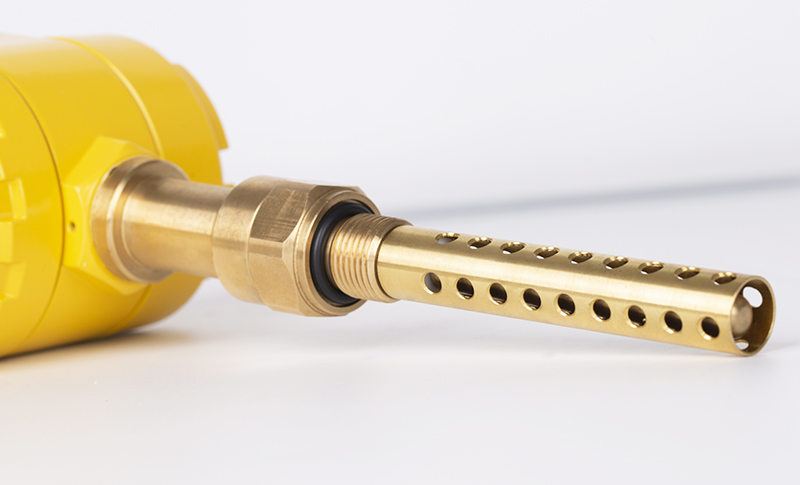
Flow switches must withstand harsh environmental conditions in real-world applications.Thermal dispersion flow switches utilize 304 stainless steel probes and housings made of PP or 304 stainless steel,providing excellent corrosion resistance and mechanical strength.They reliably operate in environments characterized by high temperatures,humidity,or corrosive gases.Furthermore,they boast an IP67 protection rating,effectively preventing the ingress of dust and water,ensuring long-term stable operation even in challenging conditions.
5. Flexible Output&Compatibility:
To meet diverse operational needs,thermal dispersion flow switches offer various output options including 4~20mA analog signals and relay,NPN/PNP switch signals.They also possess excellent compatibility and can simultaneously fulfill temperature monitoring and transmission functions.Whether for simple local alarms or complex remote monitoring systems,they adapt to different control requirements.This flexibility allows thermal dispersion flow switches to integrate seamlessly into various automation control systems,providing field operators with versatile solutions.
Working Principle Analysis
Thermal dispersion flow switches operate based on the heat transfer principle.The process is as follows:
1.Relationship between Heat Transfer and Flow Changes:As fluid passes through the pipe,the heat generated by the heating element changes based on the flow velocity.When there is no flow,the heat absorbed by the temperature sensing element remains constant.When fluid flows,the rate of heat transfer changes;the heat absorbed by the temperature sensor becomes proportional to the flow velocity.
2.Signal Conversion&Alarm Output:The temperature difference detected by the sensor is converted into an electrical signal.An internal processor analyzes this signal and outputs a standard analog signal(e.g.,4-20mA)or a switch signal(e.g.,PNP,NPN,relay).When the flow reaches a preset alarm point,the flow switch(FES)outputs an alarm signal and alerts operators via the LED indicator.
Technical Parameters Explained
Measuring Range:Accurately measures flow velocity in various media including water,oil,and gas.Typical ranges are 0.03~3 m/s for water/oil and 2~20 m/s for gas,catering to diverse industrial flow requirements.
Contact Rating&Outputs:Provides flexible output options including PNP,NPN,relay,analog,and 485 signals,allowing customization based on field requirements.Contact ratings are typically 2A/220VAC and 3A/30VDC,suitable for integration with various control systems.
Operating Environment:Designed for an ambient temperature range of-10°C to 60°C and features an IP67 protection rating.Withstands harsh conditions such as high temperatures,humidity,and dust.
Application Field Analysis
Thermal dispersion flow switches are widely used in:
Petrochemical Industry:Monitoring fluid velocity in oil/gas pipelines to prevent pump dry-running and equipment damage due to flow anomalies.
Power Generation Industry:Safeguarding system equipment in power plants and substations by monitoring coolant flow velocities.
Metallurgical&Steel Industry:Providing real-time monitoring of cooling water and lubricating oil flow to ensure smooth production processes.
Food&Papermaking Industry:Monitoring liquid flow velocity on production lines to ensure fluids remain within optimal operating parameters.
Water Treatment Industry:Detecting flow abnormalities promptly in treatment facilities to prevent efficiency loss caused by excessively low or high flow rates.
As an engineer selecting flow monitoring equipment,thermal dispersion flow switches are my preferred solution due to their accuracy,ease of setup,durability,and reliability.Whether for flow control,pump protection against dry-running,or pipeline velocity regulation,thermal dispersion flow switches deliver optimal monitoring performance,ensuring system stability and safety.For highly automated industrial systems demanding precise control,thermal dispersion flow switches are undoubtedly a reliable solution.